Author: Yiman Yang

  • Animator, Storyboard Artist, and Character Designer

    After a general overview of the animation industry, I focused my research on three core roles: Animator, Storyboard Artist, and Character Designer. These positions correspond to the main stages of production—movement performance, storytelling structure, and visual identity—and together shape a project’s emotional tone and narrative coherence.
    I plan to draw on interviews with experienced professionals and observe how they approach their work within the industry.

    Animator

    Animators make character designs move convincingly and expressively, translating design into performance under the direction of leads and directors. (For industry job descriptions that specify these expectations—including requirements to understand rhythm, weight and to collaborate with programmers and designers—see Creative Assembly’s animator/technical-animator postings.)

    Working as an animator in games often requires fluency with industry tools such as Autodesk Maya and MotionBuilder, and in 2D pipelines tools like TVPaint—these are standard in many studios’ toolsets.

    • https://www.autodesk.com/uk/products/maya/overview
    • https://www.autodesk.com/products/motionbuilder/overview
    • https://tvpaint.com/en

    Experienced practitioners and tutors stress that the heart of good animation is not simply “beautiful motion” but making a character feel real through careful timing, weight and spacing—points emphasized in Scott T. Petersen’s professional animation training materials.

    • https://www.scotttpetersenanimation.com/animation-training-dvds

    In practice, animators also confront technical constraints—unstable frame rates, engine limitations and inconsistent poses—which means continual technical learning and clear communication with programmers and designers are vital to keep a shot playable and expressive in production.

    Storyboard Artist

    Storyboard artists translate scripts into a visual blueprint that determines pacing, camera behaviour, shot composition and the emotional beats of a scene. (Framestore and other VFX/animation houses describe storyboarding as the point where cinematic knowledge, composition skills and story logic converge.)

    • https://www.framestore.com/careers

    In published interviews, professional story artists explain their role as the bridge between director and production: they must convert written beats into readable images while keeping technical feasibility in mind. For example, Eva Bruschi (Sony Pictures Animation) describes how story artists “translate words into images,” discussing composition, acting and camera thinking in her interview.

    • https://blog.animschool.edu/2018/03/23/3d-animation-interview-sony-pictures-story-artist-eva-bruschi/

    Similarly, Joe (Joseph) Castillon stresses the value of planning and pre-visualization to avoid confusion later in production; his interviews and portfolio notes highlight iteration, thumbnails and pitching multiple versions as core workflow habits.

    • https://www.vfx2go.com/blog-archive/josep-castillon
    • https://www.joecastillon.com/

    Storyboard artists commonly use Photoshop (or Toon Boom Storyboard Pro) to sketch, sequence and time shots—software that studios widely recommend for pre-production work.

    • https://www.adobe.com/uk/products/photoshop.html
    • https://www.toonboom.com/products/storyboard-pro

    Character Designer

    Character designers establish a project’s visual identity by creating figures that read clearly on screen and support believable motion. Major studios (and specialist houses) emphasize that character design must balance stylistic unity, emotional clarity and technical practicality. (Framestore/Aardman style and careers pages illustrate how design and production constraints interact in real projects.)

    • https://www.framestore.com/careers
    • https://www.aardman.com/careers/

    Designers like Adrian Grajdeanu describe their process as starting from who the character is—the backstory and personality—and then refining shape, color and costume so the design both reads emotionally and performs technically, which mirrors standard guidance in industry interviews.

    • https://talkillustration.com/interview-character-designer-adrian-grajdeanu/

    For interactive media such as games, character designers must also consider rigging compatibility, animation readability and on-screen silhouette—factors that influence choices in proportion, topology and costume detail. Practical toolsets for character concept work include Photoshop, Procreate, and Clip Studio Paint.

    • https://www.adobe.com/uk/products/photoshop.html
    • https://procreate.com/
    • https://www.clipstudio.net/en/

    Summary

    Animators supply timing, weight and expressive motion; storyboard artists define cinematic flow and camera logic; character designers build the visual language that supports both performance and story. Modern animation production asks practitioners across these roles to combine strong artistic foundations with technical fluency, teamwork and a habit of ongoing learning—points supported by studio job descriptions and first-hand interviews referenced above.
  • Career Aspirations and Target Companies

    I aim to work in game animation( Game preview Video) and contribute to independent animation projects, while also exploring roles in concept art or character design. I prefer creative hubs like Shanghai, Hangzhou, London, or Hong Kong for their vibrant game and animation industries. My research confirms that companies in these cities fit my goals:

    • NetEase Games

    – A leading global game developer/publisher headquartered in Hangzhou . NetEase has built a worldwide studio network (including offices in Tokyo, Montréal, and the UK) . Its portfolio includes high-profile titles like Onmyoji, Harry Potter: Magic Awakened, and NARAKA: Bladepoint . Job postings at NetEase emphasize skills in 2D/3D animation, visual design, and storytelling, reflecting their focus on cinematic game experiences. I am especially drawn to NetEase’s integrated creative pipeline that unites world-building, art direction, and technology. In future, working at NetEase’s London or Shenzhen studio would let me deepen my skills in game storytelling and cinematic animation.

    • Blue Zoo Animation Studio

    – A British animation studio based in London (Fitzrovia) that has won multiple BAFTA and Emmy awards . Blue Zoo is known for its distinctive, character-driven style; its notable productions include Alphablocks, Numberblocks, The Adventures of Paddington, and the Netflix series Big Tree City . The studio emphasizes expressive performance and timing, and it balances commercial work with creative experimentation. I admire Blue Zoo’s Blue Zoo Academy training program, which helps emerging animators learn industry-standard tools (e.g. Maya, Toon Boom, After Effects). A campus visit to Blue Zoo confirmed how their projects range from polished TV series to playful shorts, matching my interest in diverse animation styles.

    • KAZE Studio

    – A Shanghai-based animation studio composed of a “young, creative and passionate” team . KAZE specializes in both 2D and 3D animation, advertising, and illustration . Its portfolio includes work for major brands: for example, KAZE produced a Coca-Cola “Spring Panda” commercial, and even collaborated with renowned manga director Katsuhiro Otomo (on the FREEDOM ad) . This confirms KAZE’s global reach and creative ambition. I’m attracted to KAZE’s flexible, energetic culture, which seems to foster both professional growth and artistic freedom.

    Summary

    Overall, this research highlights the range of animation production environments available. Large game companies like NetEase focus on technical collaboration and large IPs, whereas creative studios like Blue Zoo and KAZE emphasize storytelling, style, and experimentation. I aspire to bridge these worlds – using strong technical skills (animation pipelines, 3D tools) and artistic sensibilities – to help create visually compelling, emotionally engaging animations. Moving forward, I will target roles at studios that offer both solid production experience and room for creative growth, contributing to projects that delight global audiences.

    References

    NetEase Games :

    https://www.neteasegames.com

    https://www.neteasegamesmtl.com/careers

    https://www.neteasegames.com/news/netease-games-opens-new-london-studio

    Blue Zoo Animation Studio :

    https://www.blue-zoo.co.uk

    https://www.blue-zoo.co.uk/careers

    Blue Zoo Academy :

    https://www.bluezooacademy.com

    Kaze Studio :

    https://baike.baidu.com/item/kaze%E5%8A%A8%E7%94%BB%E5%B7%A5%E4%BD%9C%E5%AE%A4/4583986

  • My Interests: Game PVs and Independent Animation

    My interest in animation centers on two areas: the production of game PVs (promotional videos) and the creation of independent animation. These fields differ in production processes, funding models, and team structures, yet both demand strong storytelling and compelling visual design. By comparing a commercial studio example (NetEase Games) with an independent studio model (Studio Ghibli), I aim to clarify how career paths and creative freedom vary across these contexts.

    1. Game PV Animation — Case Study: NetEase Games

    In the game industry, animation sits at the intersection of technology and artistic craft. Game animators must be fluent with tools such as Maya, MotionBuilder, and Blender; they are responsible not only for producing convincing character motion but also for ensuring that animations perform smoothly in a real-time environment.
    NetEase Games’ careers pages emphasize that animators “work with programmers, planners, and artists to complete real-time motion systems,” which highlights how technical knowledge and cross-department collaboration are as important as pure artistic skill.

    For promotional work, PVs play a crucial role in communicating a title’s world, characters, and visual identity. These cinematic pieces appear in marketing campaigns for new releases, updates, new characters, or seasonal events—serving to attract both players and a broader audience.
    A representative example is the Li Bai: Sharp Power PV (produced in partnership with NetEase’s animation collaborators). It blends dynamic character movement, expressive lighting, and cinematic editing to capture attention and build cultural visibility. This case demonstrates how well-executed game PVs can amplify a game’s brand and narrative impact.

    1. Independent Animation — Case Study: Studio Ghibli

    Independent studios such as Studio Ghibli prioritize personal expression, narrative depth, and emotional nuance over large-scale industrial workflows. Directors frequently engage directly in storyboard work, character design, and timing decisions, so although projects may be smaller in scale, they often allow far greater creative autonomy.

    Documentaries like The Kingdom of Dreams and Madness and 10 Years with Hayao Miyazaki reveal Miyazaki’s hands-on approach: he reviews and refines individual shots, motions, and backgrounds to preserve a consistent “Miyazaki style.” Even while adopting digital tools, he maintains a hand-drawn 2D aesthetic and carefully balances traditional drawing with modern assistance. Miyazaki’s “drawing while thinking” method—developing story and emotion as he sketches—is evident in productions such as Ponyo, where site visits to the Seto Inland Sea informed the film’s atmosphere and settings. This process shows how independent animation weaves observation, feeling, and visual storytelling into a continuous creative practice.

    Conclusion

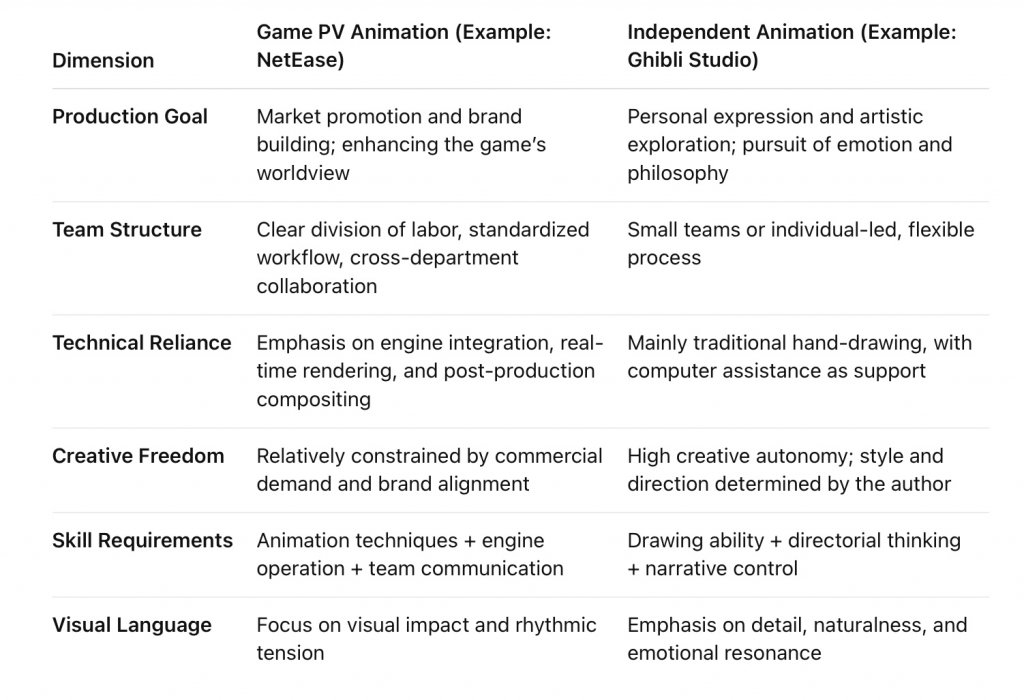
    I summarized the key differences between game PVs and studio-led animations in a chart to visualize contrasts in workflow, team roles, and creative control. These case studies have sharpened my career goals and interview preparation: in my portfolio I intend to combine the narrative clarity and visual voice of independent work with the technical proficiency and collaborative skills required for commercial game production.

    References:

    https://www.neteasegames.com/careers/en

    https://montreal.neteasegames.com/careers/pm/animation/20191030/31808_842178.html

    https://gamedesignskills.com/game-art/video-game-animator

    https://www.talentlyft.com/template/game-animator-job-description

    https://www.imdb.com/title/tt3204392

    https://www.cinema-adrift.com/blog/2015/10/31/film-review-the-kingdom-of-dreams-and-madness-mami-sunada-2013

  • Hello world!

    Welcome to myblog.arts. This is your first post. Edit or delete it, then start blogging!